Course Description
| Target Audience | Auditors, risk and compliance officers, finance managers, controllers, business unit heads, and public sector officials |
INTRODUCTION
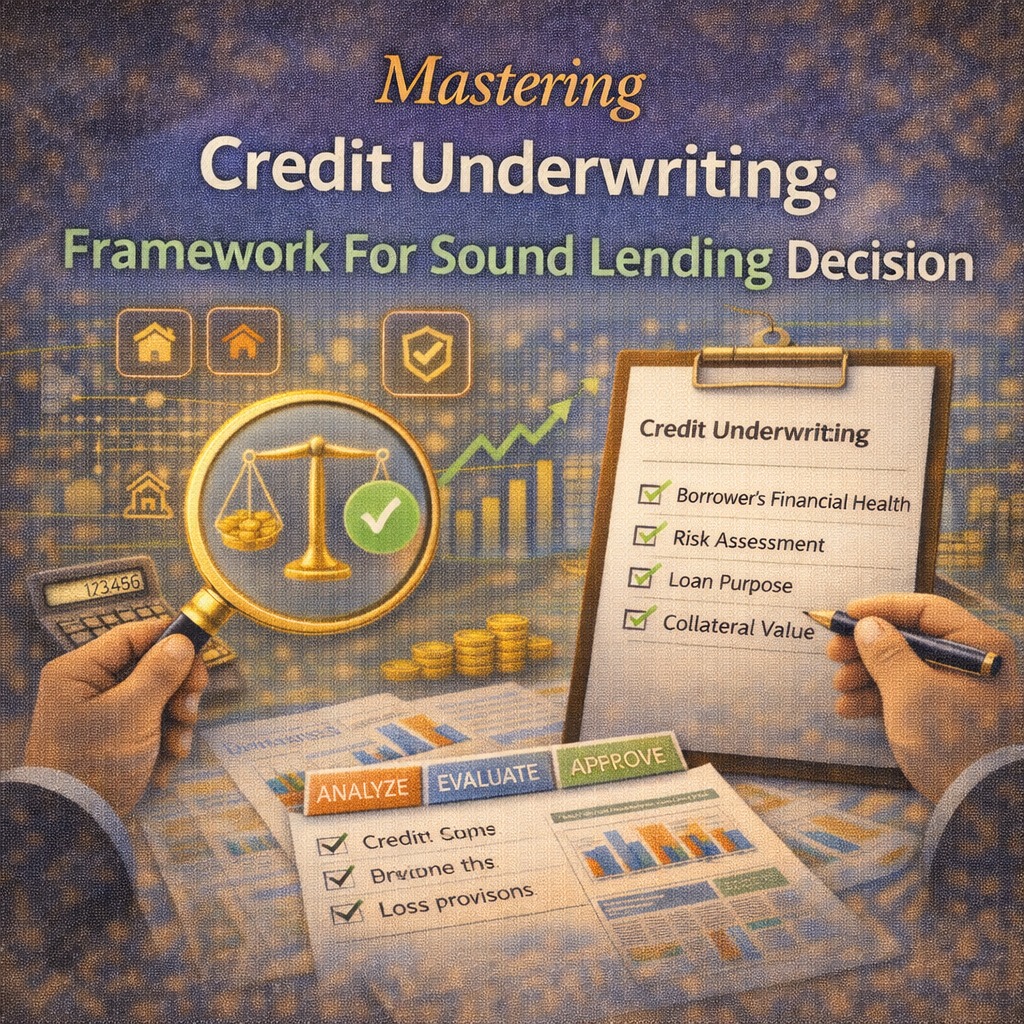
Sound credit decisions are the foundation of every successful lending institution. Professionals must combine speed with accuracy to stay competitive while protecting against losses. Mastering Credit Underwriting: Framework for Sound Lending Decision is designed to provide a clear, practical approach to evaluating borrowers, analyzing financial health, and applying risk-based decision-making.
Through real-world case studies and interactive learning, participants will gain the tools to identify red flags, structure facilities effectively, and strike the right balance between compliance, risk mitigation, and business growth.
By the end of this program, attendees will be equipped to make lending decisions that safeguard institutional value while driving sustainable opportunities.
COURSE OBJECTIVES
At the end of the session, participants will be able to:
- Understand the fundamentals and importance of credit underwriting in lending decisions.
- Analyze financial statements and assess borrower cash flows and debt service capacity.
- Identify and evaluate non-financial risks that impact creditworthiness.
- Detect early warning signs of credit deterioration and borrower distress.
- Structure credit facilities that align with institutional risk appetite and borrower needs.
- Prepare comprehensive credit memos and defend lending recommendations.
- Balance risk mitigation with business growth objectives in credit decisions.
COURSE OUTLINE
Module 1: Understanding the Credit Underwriting Landscape
- Role of credit underwriting in financial institutions
- Lending objectives: profitability vs prudence
- Relationship between risk, return, and decision-making
- Regulatory and policy frameworks shaping credit practices
- Global and local trends in credit underwriting
Module 2: The Fundamentals – The 5 Cs of Credit
- Character, Capacity, Capital, Collateral, and Conditions explained
- Weighting and prioritization of the 5 Cs across industries
- Integrating ESG (Environmental, Social, Governance) into credit assessment
- Practical discussion: Applying the 5Cs to SME vs Corporate borrowers
Module 3: Financial Statement Analysis for Credit Decisions
- Understanding income statements, balance sheets, and cash flow statements
- Differentiating profit vs cash – why liquidity matters more
- Key ratios: DSCR, leverage, liquidity, profitability, efficiency
- Common pitfalls in financial statement analysis
Module 4: Borrower Cash Flow & Debt Serviceability Assessment
- Building a borrower cash flow profile
- Assessing repayment capacity under different scenarios
- Stress-testing assumptions (interest rate hikes, FX volatility, inflation)
- Case study: Cash flow analysis for a manufacturing company
Module 5: Assessing Non-Financial Risks
- Industry, market, and business model evaluation
- Management quality, governance structures, and ownership risks
- Legal, environmental, and reputational considerations
- Behavioural indicators: soft signals of borrower reliability
Module 6: Identifying Red Flags and Early Warning Signs
- Common borrower red flags in documentation & disclosures
- Over-leverage, refinancing patterns, liquidity mismatches
- Warning signals of distress: declining sales, high debt turnover, late payments
- Leveraging credit scoring tools, rating models, and internal risk models
Module 7: Structuring and Documenting Credit Facilities
- Choosing facility types: term loans, overdrafts, revolving lines, trade finance
- Tenor, repayment structures, pricing, and security requirements
- Designing covenants and monitoring mechanisms
- Writing a solid credit memo & defending recommendation
- Common underwriting mistakes and how to avoid them
Module 8: Portfolio Monitoring, Risk Mitigation & Remediation
- Post-disbursement monitoring: tools and techniques
- Ongoing borrower review and covenant tracking
- Identifying problem loans early and corrective measures
- Loan restructuring and recovery strategies
- Balancing business growth with portfolio stability
Course Details
- Duration: 2 days
-
Available Formats:
- Virtual Attendance - ₦165,000
- Physical Attendance - ₦187,500
-
Available Dates:
- Feb 18, 2026
- May 25, 2026